+86 13777722188


Choosing an Insulated Cable supplier in China involves more than comparing quotations. Global buyers need to assess product quality, manufacturing capability, communication, and delivery reliability. A cable may look suitable on a specification sheet, yet perform differently when installation conditions change. That detail matters.
This guide examines how buyers can identify leading Chinese suppliers and compare them with practical criteria. It considers product range, such as building wires, power cables, and cables designed for industrial use. It also looks at conductor materials, insulation types, voltage ratings, testing records, and customization options. Ask suppliers for clear technical documents and sample details. Check whether stated specifications match the project’s operating environment, including temperature, moisture, and mechanical stress. Small mismatches can become costly.
Price still matters. But it should not stand alone. Buyers can review production capacity, quality-control procedures, export experience, packaging, and expected lead times before placing an order. Independent inspections or sample testing may help confirm claims, though they cannot replace careful project-specific evaluation. Communication deserves attention too; vague answers about test methods or delivery schedules are worth clarifying. Not every supplier will fit every project. Some details may remain uncertain until samples are tested or production begins. This guide offers a grounded starting point for comparing suppliers, asking sharper questions, and making a more informed sourcing decision.
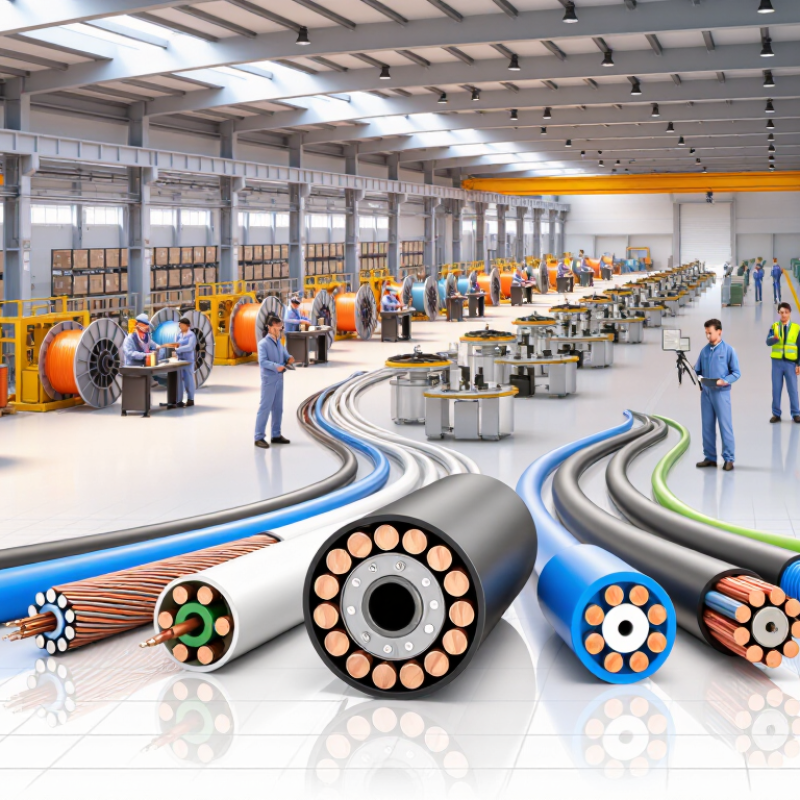
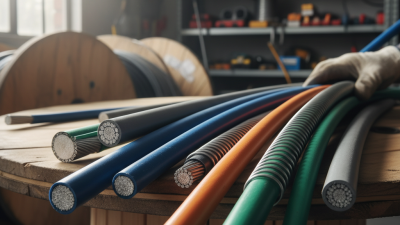
China’s cable manufacturers supply several insulation types, each suited to different operating conditions. PVC-insulated cables are common in building circuits and control wiring, where cost and straightforward installation matter. XLPE-insulated power cables handle higher temperatures and are widely used in distribution networks. For renewable-energy projects, manufacturers also supply photovoltaic cables designed for outdoor exposure and repeated temperature changes. Check the datasheet carefully; “solar cable” alone does not specify voltage rating or environmental performance.
Rubber-insulated cables offer flexibility for equipment and movable connections, while mineral-insulated cables are selected where fire resistance is critical. Control and instrumentation cables may include shielding to reduce electrical interference near motors or variable-speed drives. IEC 60502-1 provides requirements for extruded-insulation power cables in defined voltage classes, helping buyers compare specifications rather than labels. The IEA’s Renewables 2023 report projected nearly 3,700 GW of renewable capacity additions worldwide during 2023–2028. That expansion increases demand for plant, grid, and connection cabling, though project conditions vary sharply. A cable suitable for a dry indoor panel may fail prematurely in a humid, sun-exposed installation. Buyers should match insulation, conductor size, temperature rating, and test documentation to the actual route. Details matter.
A reliable insulated cable supplier should explain which standards apply to the cable’s intended use, rather than presenting a long list of certificates. Ask for the exact standard number, edition, rated voltage, conductor material, and insulation type. Small details matter. A 0.6/1 kV power cable and a control cable may look similar on a warehouse reel, but they serve different purposes.
Request test reports that identify the product model and test method. Check whether the report covers conductor resistance, insulation thickness, voltage withstand, and ageing performance where relevant. For projects with fire-performance requirements, confirm the specific test classification and the conditions under which it was measured. A certificate alone may not show whether the tested sample matches the cable being quoted. Ask how production batches are identified and how test records can be traced to a shipment.
Supplier audits and sample checks add useful context. Inspect how conductors are measured, how insulation is extruded, and how finished reels are labeled. Compare a delivered sample with the approved specification, including markings and dimensions. A polished PDF is not proof. Nor is one successful sample a guarantee of every batch. I would treat unclear answers about test scope or traceability as a reason to pause and ask again. Some requirements vary by market, so confirm them with the project engineer before placing an order.
China’s Leading Insulated Cable Supplier Categories
Insulated cable suppliers in China generally serve several distinct needs. Building-wire manufacturers focus on low-voltage cables used behind walls, in lighting circuits, and in commercial buildings. Their key specifications include conductor size, insulation material, temperature rating, and fire performance. Medium- and high-voltage suppliers serve utilities, substations, and large industrial sites, where insulation integrity and factory testing matter greatly. Small defects can have costly consequences.
Renewable-energy and industrial suppliers make cables for solar arrays, wind installations, machinery, and control systems. These products may need resistance to sunlight, oil, abrasion, or repeated movement. Categories can overlap, so buyers should compare the actual application and test documentation, not just a catalogue label. A cable described as “industrial” may not suit every environment.
The International Energy Agency’s 2023 report, Electricity Grids and Secure Energy Transitions, says annual grid investment must rise above $600 billion by 2030, from about $300 billion today. That estimate underscores why dependable power-cable supply matters. Still, investment forecasts do not prove that any particular supplier can meet a project’s requirements. Request current test reports, conductor and insulation details, production traceability, and samples for evaluation. Details matter. Supplier categories are a starting point, not a quality guarantee.
Global buyers should examine quality control before comparing cable prices. The real test begins with raw material inspection. Suppliers should verify copper purity, conductor resistance, and insulation compound records. During extrusion, operators need to monitor diameter, wall thickness, and eccentricity. Small variations can create serious installation problems later.
Testing should cover routine and type requirements under relevant IEC or regional standards. Common checks include high-voltage withstand, insulation resistance, conductor resistance, flame performance, and tensile strength. For medium-voltage cables, partial discharge testing deserves special attention. Every result should identify the production batch, test date, equipment, and responsible technician. Calibration records matter too. They are often ignored.
Certificates can mislead. A supplier may provide a valid document for a different cable structure, voltage rating, or conductor material. Buyers should match the certificate with the exact product specification. Request factory test reports, declarations of conformity, material certificates, and independent laboratory reports where required. An accredited laboratory following ISO/IEC 17025 adds useful credibility. Factory audits can also confirm storage conditions, sample retention, and traceability. I have found that clear records reveal more than polished brochures. Still, no audit catches everything. Buyers should define acceptance criteria, witness selected tests, and inspect packaging before shipment. Photos of sealed drums, length markings, and moisture protection provide practical evidence.
China offers a deep manufacturing base for insulated cables, but low prices alone do not prove quality. The International Energy Agency’s Electricity 2024 report forecasts global electricity demand to grow by about 3.4% annually from 2024 to 2026. This growth increases pressure on buyers to secure stable, traceable cable supplies.
Define the application before contacting Chinese suppliers. Record voltage, conductor size, installation temperature, bending radius, moisture exposure, and fire-performance needs. Then compare construction details, including copper purity, insulation material, screen design, and sheath thickness. IEC 60228 helps verify conductor classes, while IEC 60502-1 covers many power cables rated up to 1 kV and 3 kV. Ask for routine test records, type-test evidence, material declarations, and production dates. A sample should match the final purchase specification.
Inspect more than the showroom. Request factory photos, calibration records, batch traceability, and independent inspection before shipment. Check whether the supplier can repeat the same insulation thickness across several drums. Small differences matter. Packaging also deserves attention; sealed ends and moisture-resistant wrapping protect cable during long transport. A spreadsheet may look complete, yet one missing test condition can invalidate the comparison. I would also order a small trial batch before signing a large contract. It costs more initially, but it can reveal printing errors, poor flexibility, or inconsistent conductor resistance.
| Cable Category | Common Standard | Typical Rated Voltage | Insulation and Temperature | Typical Application | Key Checks Before Purchase |
|---|---|---|---|---|---|
| Low-voltage power cable, PVC insulated | IEC 60227 series; conductor requirements may reference IEC 60228 | Up to 450/750 V for applicable IEC 60227 cable types | PVC insulation; allowable operating temperature depends on the cable type and its specification | Fixed wiring and general low-voltage installations where the selected cable type is suitable | Confirm the exact cable designation, conductor class, core count, voltage rating, installation method, and applicable national requirements. |
| Low-voltage power cable, XLPE insulated | IEC 60502-1; conductor requirements may reference IEC 60228 | 0.6/1 kV | XLPE insulation; commonly designed for a maximum conductor operating temperature of 90°C under specified conditions | Power distribution in buildings, industrial facilities, and infrastructure projects | Check conductor material and class, insulation and sheath materials, conductor size, core identification, and declared operating conditions. |
| Medium-voltage power cable | IEC 60502-2 | Rated voltages from 6/10 kV up to 18/30 kV; selection depends on system voltage and earthing conditions | Typically XLPE insulated; design and test requirements vary with rated voltage and construction | Distribution networks, substations, and industrial medium-voltage systems | Specify U0/U(Um), conductor size, screen design, metallic screen cross-section, installation conditions, and required routine and type-test evidence. |
| Building wire, PVC insulated | IEC 60227 series for applicable cable types | Common types include ratings up to 450/750 V | PVC insulation; temperature limits are cable-type specific | Conduit, trunking, or fixed wiring installations where permitted by local electrical codes | Verify local certification requirements, conductor class, insulation thickness, color identification, and suitability for the intended installation. |
| Fire-performance cable | Requirements depend on the project specification and the applicable fire-test standard | Must be selected to match the circuit voltage rating | Fire resistance, flame retardance, low smoke, and halogen-free properties are distinct performance claims | Emergency circuits, evacuation systems, public buildings, and other applications specified by the project | Request test reports for the exact cable construction and test method; do not treat flame-retardant performance as equivalent to circuit integrity during fire. |
| Supplier and order verification | Purchase specification, applicable IEC or national standard, and contract requirements | Match the approved design and local system requirements | Require material and performance details for the complete cable construction | Supplier qualification, quotation review, production, inspection, and shipment | Check factory capability, product-specific certificates and test reports, sample approval, agreed tolerances, inspection plan, packaging, lead time, and export documentation. |
Procurement note: Cable ratings and permitted uses depend on the exact construction, installation conditions, and destination-market regulations. Confirm the final specification and required approvals with the project engineer and the relevant authorities before ordering.