What Are the Top Types of Aerial Cable?
Aerial Cable is a broad term for cables installed above ground on poles or other supports. The right type depends on what it carries, how far it spans, and the conditions along the route. A quiet residential street, a windy ridge, and an industrial site can each call for different construction. There is no single best option.
Common choices include aerial fiber-optic cable, all-dielectric self-supporting cable, figure-eight cable, and messenger-supported cable. Each handles support and environmental loads differently. For example, figure-eight cable has a strength member joined to the cable, while messenger-supported designs rely on a separate supporting wire. ADSS cable uses a nonmetallic structure and may suit routes where conductive components are undesirable. Details matter.
This guide compares the leading types by structure, typical use, and practical trade-offs. It also explains what to check before selection, including span length, wind and ice exposure, attachment hardware, and installation requirements. Small details can change the decision. A cable that looks suitable on a product sheet may not fit the pole spacing or existing network hardware. That distinction is easy to miss.
Specifications should be checked against the manufacturer’s documentation and reviewed by qualified network or utility professionals. Conditions vary. The categories are useful starting points, not a substitute for site assessment. Choosing carefully can improve reliability and avoid unnecessary maintenance, though no cable type removes every risk.
Classify Aerial Cables by Power or Telecom Use and Support Design
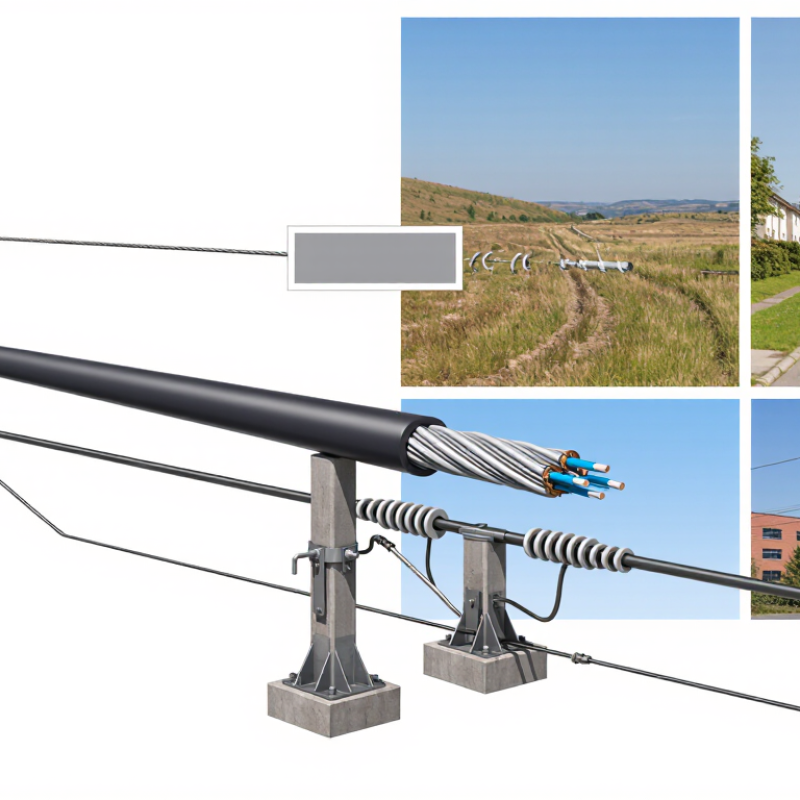
Aerial cables are classified by what they carry and how they are supported. Power lines may use bare conductors, covered conductors, or bundled insulated cables. Bare conductors depend on insulators and clearances, making pole spacing and nearby vegetation important. Covered conductors have a protective layer, but that layer does not necessarily make them safe to touch. Details matter.
Telecom cables include fiber-optic and copper designs. ADSS fiber cable supports itself between poles without a separate messenger, using built-in strength members. Figure-eight cable has a messenger integrated into its profile. Other cables are lashed to a separate support strand, which carries much of the mechanical load. Check the span.
Support design affects installation and maintenance. Engineers consider cable weight, tension, wind, ice, pole strength, and required electrical clearances. A telecom cable placed near power lines also needs suitable separation and hardware. The right design depends on the route, not just the cable label. A tidy category chart can hide real differences between products, so verify construction details and site conditions before specifying a cable.
Compare Bare ACSR Conductors Under ASTM B232
What Are the Top Types of Aerial Cable?
Bare ACSR is a common choice for overhead transmission and distribution lines. It combines conductive aluminum strands with a steel core for added mechanical strength. ASTM B232/B232M specifies construction and material requirements for this conductor type, including wire stranding and tensile properties. A common 26/7 design has 26 aluminum strands around seven steel strands. The exact dimensions and strength depend on conductor size and construction.
Compare ACSR with all-aluminum conductor (AAC) and aluminum-alloy conductor (AAAC). AAC offers high conductivity but less tensile strength than steel-reinforced ACSR. AAAC uses alloy strands and can suit lines where corrosion resistance and strength matter. ASTM specifications help buyers compare defined construction details, but they do not establish a universal ampacity. IEEE Std 738-2023 calculates conductor current ratings using factors such as wind, sunlight, ambient temperature, and conductor resistance. Small weather changes matter. A rating from one site may not transfer neatly to another.
Tips: Check the specified stranding, nominal area, rated strength, and resistance—not just the cable label. Then confirm operating temperature and local weather assumptions with an engineer. One common mistake is comparing ampacity figures from different conditions. It is easy to miss. Verify the assumptions before selection.
Review Aerial Bundled Cable at IEC 60502-1’s 0.6/1 kV Rating
Aerial bundled cable (ABC) at 0.6/1 kV can suit low-voltage distribution, but its voltage rating alone does not confirm overhead suitability. IEC 60502-1 covers power cables with extruded insulation rated 0.6/1 (1.2) kV and 1.8/3 (3.6) kV, including construction and test requirements. A useful distinction. The standard is not a complete pole-line design rule. Exposure, support spacing, fittings, and installation practice also matter. Check conductor details, insulation, temperature limits, and declared resistance to sunlight and weather before specifying a bundle.
The grid context is expanding. The International Energy Agency’s 2023 Electricity Grids and Secure Energy Transitions report estimates that over 80 million kilometres of grids must be added or refurbished by 2040. That scale puts practical low-voltage choices under pressure. Yet a tidy datasheet can hide site conditions: a tight bend near a clamp, intense sun on a span, or uneven sag may reveal issues a voltage label cannot.
Not a small detail. IEC compliance should be checked alongside the cable’s intended aerial use and the installation conditions.
Identify ADSS Fiber Cable Using ITU-T G.652 Single-Mode Fiber
Among aerial cable types, ADSS is designed to hang from poles without a metallic messenger. Its all-dielectric construction helps distinguish it from messenger-supported designs, but appearance alone is not reliable. The jacket may conceal the cable’s actual fiber type.
To identify ADSS cable using ITU-T G.652 single-mode fiber, check the sheath legend and product documentation. Look for “ADSS” and a clear reference to G.652 fiber. G.652 describes the optical fiber, not the cable’s support design. Both details matter. A cable can contain G.652 fiber without being ADSS.
Inspect the construction record for dielectric strength members and confirm the cable’s rated span and installation tension. These details affect safe placement between poles. G.652 fiber is commonly used for long-distance links and supports transmission around 1310 nm and 1550 nm, subject to the system design. A field label may be faded or incomplete. Don’t guess from jacket color. Verify the fiber specification and cable structure with reliable documentation before installation. That extra check can prevent a costly mismatch.
What Are the Top Types of Aerial Cable?
Identify ADSS fiber cable by its all-dielectric, self-supporting construction. The chart shows maximum attenuation limits for ITU-T G.652.D single-mode fiber at selected wavelengths; these are specification limits, not measured results from a particular cable.
Aerial cable types include ADSS, messenger-supported cable, and lashed cable. Fiber attenuation limits help describe the optical fiber inside a cable, but do not alone identify its aerial construction. Reference: ITU-T G.652.
Distinguish Figure-8 Cable from Messenger-Supported Designs
The Fiber Broadband Association’s 2024 Fiber Deployment Annual Report estimated that fiber networks passed about 78 million U.S. homes in 2023. At that scale, aerial cable design is a practical decision, not a cosmetic one. A figure-8 cable joins the fiber core to a messenger wire through a narrow web. The messenger carries the span load while the optical cable hangs below. Crews handle one assembled unit. That can simplify installation on routes with consistent pole spacing.
Messenger-supported designs keep the support strand separate. Crews tension the strand, then lash the cable to it. This adds hardware and labor, but can make later cable replacement or capacity upgrades more flexible.
It may suit routes with uneven spans or existing strand infrastructure.
The tradeoff is real.
Wind, ice, sag, pole strength, and span length all affect suitability. A figure-8 profile alone does not guarantee safe clearance or adequate support. Check the cable’s tension data and have the route assessed against site conditions. Installation speed matters, but it is not the whole story; future access and maintenance deserve attention too.



 +86 13777722188
 WHATSAPP
 PHONE
 E-MAIL